
Time: 2026-10-29 Click: 3 seen
In the industrial sector, oil and gas-fired boilers are gaining popularity among an increasing number of companies due to their high thermal efficiency, clean and environmentally friendly operation, and high level of automation. However, many companies still face uncertainty when selecting an oil or gas-fired boiler: should they choose a WNS oil and gas-fired boiler (horizontal internal fire tube boiler) or an SZS oil and gas-fired boiler (double-drum water tube boiler)?
This article focuses on the main differences between SZS water-tube boilers and WNS fire-tube steam boilers, covering aspects such as boiler body structure, evaporation capacity, pressure rating, and performance characteristics:
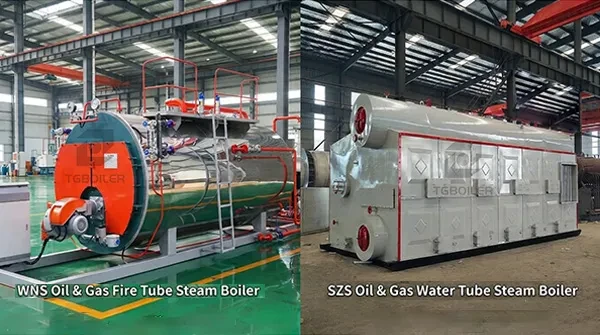
WNS Series Fire Tube Boilers (Horizontal Internal Steam Boilers): These are fire-tube boilers that typically feature a horizontal three-pass fire-tube design.
SZS Series Water-tube Boilers (Double-drum Water-tube Boilers): These are water-tube boilers that are often arranged in a “D” configuration and utilize a fully membrane-type water-wall structure.
WNS Series Fire Tube Boilers: With a compact structure limited by the diameter of the boiler shell, these are primarily suitable for small- to medium-sized boilers with a capacity of less than 20 tons per hour (commonly ranging from 1 to 20 t/h).
SZS Series Water-tube Boilers: Featuring a large furnace space and flexible structure (full-membrane water-cooled wall design), these are suitable for high-capacity applications (typically 10 tons per hour or more).
WNS Series Fire Tube Boilers: Operating pressures are typically 1.6 MPa or lower in conventional low-pressure environments, producing saturated steam.
SZS Series Water-tube Boilers: Capable of operating in medium- to high-pressure environments exceeding 2.5 MPa; can be equipped with superheaters to produce superheated steam at higher temperatures with greater purity.
WNS Series Fire Tube Boilers: Suitable for industries with relatively stable steam loads and less stringent requirements for steam superheat and dryness.
SZS Series Water-tube Boilers: Suitable for industries with significant fluctuations in steam load or extremely high requirements for steam quality (high pressure, high dryness, or even superheated steam).
WNS Series Fire Tube Boilers: Suitable for enterprises with limited budgets and compact boiler room spaces. The WNS series fire tube boiler is factory-assembled, featuring a short installation cycle and low costs.
SZS Series Water-Tube Boilers: Suitable for large enterprises with ample budgets and sufficient space for boiler foundations.
| Comparison Dimension | WNS Series Fire Tube Steam Boiler | SZS Series Water Tube Boiler |
| Boiler Structure | Horizontal, internally fired, 3-pass fire tube structure | Double drum, longitudinal arrangement water tube structure |
| Steam Capacity | Typically ranges from 1 t/h to 20 t/h | Broader range & higher load capacity, typically 6 t/h to 120 t/h |
| Working Pressure | Medium-to-low pressure (below 1.6 MPa), saturated steam | Wide pressure range, supporting medium, high, and ultra-high pressure |
| Steam Quality | Mainly saturated steam | Excellent; easily delivers high-parameter superheated steam |
| Thermal Efficiency | Up to 98% with an economizer | Up to 98.5% |
| Transport & Installation | Packaged/skid-mounted, fast site installation with pipeline connection | Complex structure; large capacities require modular shipping or field assembly |
| Footprint & Initial Investment | Compact footprint, lower initial investment | Larger footprint, higher initial investment and overall cost |
For steam outputs below 10 t/h where only saturated steam is required, select the WNS series fire-tube boiler.
For steam outputs above 20 t/h, or where the pressure exceeds 2.5 MPa, or where superheated steam is required, select the SZS series water-tube boiler.
For seasonal steam use, intermittent production, and minimal load fluctuations, the WNS series fire tube boiler offers the best value for money.
For 24-hour continuous heavy industrial production with extremely high requirements for steam supply reliability, the SZS series water-tube structure provides greater resistance to shock and a longer service life.
Tel/Fax: 0086 371 63311291
WhatsApp/WeChat: 0086 13598899826
Email:info@taiguoboilers.com
Add: No.6 Zone, North Side of Konggang No.6 Road, Airport Economy Zone, Zhengzhou City, Henan Province, China




 0086 13598899826
 0086 13598899826
 info@taiguoboilers.com
