
Time: 2026-07-30 Click: 142 seen
In the production of rubber products (such as tires, conveyor belts, and rubber hoses), steam boilers are the core equipment of a factory. From the internal mixing of rubber compounds and calendering to vulcanization and molding, an efficient and stable steam supply directly impacts the quality of rubber products, the factory’s pass rate, and the facility’s overall energy consumption costs.
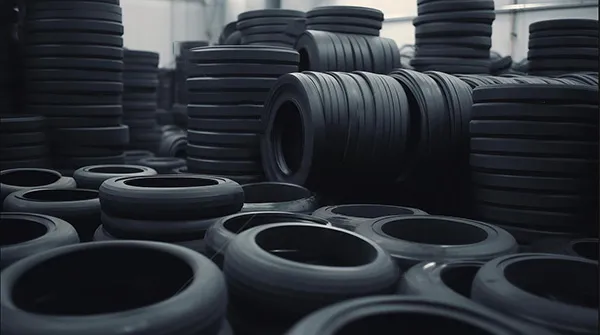
However, many rubber processing plants still face challenges when selecting equipment during plant construction or upgrades: choosing a boiler with too high a steam capacity wastes fuel, while one with too low a capacity results in insufficient vulcanization pressure; unstable pressure affects product quality; and there are strict environmental regulations to comply with...
How should a rubber plant select a high-efficiency, well-matched, and cost-effective steam boiler system? Starting from the core thermal energy requirements of the rubber manufacturing process, this article provides an in-depth introduction to the details of the selection process.
Rubber processing involves key processes such as rubber vulcanization, heating and softening of raw materials, and product drying. Among these, vulcanization places the highest demands on steam quality.
Rubber vulcanization requires a stable and uniform heat source. This process demands extremely stable temperature and pressure:
Pressure Requirements: The operating pressure for general vulcanization processes ranges from 0.6 to 1.5 MPa. High-pressure or specialty products may require higher pressures; when selecting a boiler, its rated operating pressure should be 1.1–1.2 times the maximum pressure at the steam consumption point.
Temperature Stability: Since steam has high latent heat and provides uniform heat transfer, the boiler must be equipped with stable automatic pressure regulation and temperature control capabilities to prevent uneven vulcanization, under-vulcanization, or over-vulcanization caused by pressure fluctuations.
Quality Requirements: The system must ensure high steam dryness and the absence of condensate carryover to guarantee uniform heat transfer.
Vulcanization chambers and vulcanizers in rubber factories typically operate intermittently. When multiple vulcanization units are heated simultaneously, steam demand can surge instantly, resulting in significant fluctuations in steam load. The boiler should therefore possess excellent heat storage and load regulation capabilities.
1. Determine Steam Volume (Tonnage): Calculate the total steam demand based on the number of vulcanizers, plate vulcanizers, drying rooms, and other equipment, along with their simultaneous usage factor, and allow for a 10%–20% margin.
2. Determine Operating Pressure: Determine the pressure by working backward from the maximum temperature required for the rubber vulcanization process. Generally, the vulcanization of tires or rubber products requires saturated steam at 0.8 MPa to 1.5 MPa; when selecting a boiler, the rated pressure should be slightly higher than the process requirement.
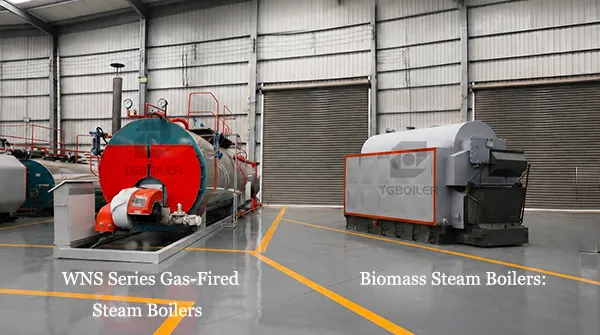
1. WNS Series Gas-Fired Steam Boilers: Featuring a large steam space, energy efficiency, low-nitrogen emissions, and a high degree of automation, these boilers are suitable for regions with piped natural gas supply. The WNS series horizontal internal combustion boilers are recommended.
2. Biomass/Coal-Fired Steam Boilers: These offer lower fuel costs and are suitable for regions where environmental regulations permit their use and biomass fuels (such as wood chips and straw pellets) are abundant. They must be equipped with a steam accumulator. Since solid fuels have a slower response time, the steam accumulator helps balance peak and off-peak demand, enabling rapid steam replenishment during sudden spikes in steam usage by vulcanization equipment and ensuring that pressure does not drop.
Condensate Recovery System: The steam condensate generated during the vulcanization process is of high quality and contains a very high amount of heat. Establishing a closed-loop condensate recovery system to return the high-temperature water directly to the boiler feedwater tank can reduce fuel consumption by 10%–15%.
High-Efficiency Economizers and Air Preheaters: Utilizing waste heat from flue gases to preheat boiler feedwater or combustion air can boost boiler thermal efficiency to over 98%.
Water Softening and Deaeration: High-quality feedwater significantly reduces boiler scaling, ensures heat transfer efficiency remains consistent, and extends the boiler’s service life.
Selecting the right steam boiler not only provides stable thermal energy and vulcanization pressure for rubber production but also effectively reduces energy consumption, protects the environment, and enhances overall economic efficiency.
💡 Get a free, customized selection plan for your rubber factory
Not sure what boiler capacity (in steam tons) your production line requires?
Henan Taiguo Boiler Manufacturing Co., Ltd. has decades of experience in industrial boiler R&D and manufacturing and has successfully customized high-efficiency thermal energy solutions for numerous rubber product manufacturers worldwide.
📞 Contact our dedicated engineers for a free quote and thermal energy solution!
Email: info@taiguoboilers.com WhatsApp: +86 13598899826
Tel/Fax: + 86-371-6331 1291
WhatsApp/WeChat: 8613598899826
Email:info@taiguoboilers.com
Add: 13th Floor, Building B, Zhengshang Xuefu Square, No. 277 Boxue Road, Zhengdong New District, Zhengzhou, Henan, China




 8613598899826
 8613598899826
 info@taiguoboilers.com
