
Time: 2026-11-12 Click: 4 seen
Industrial gas-fired boilers are boilers that use fuels such as natural gas, biogas, and coke oven gas. These boilers offer advantages such as high efficiency, energy savings, clean operation, and environmental friendliness, making them widely used in industries such as textile mills, breweries, food processing plants, and garment factories. This article primarily introduces the internal structure of industrial gas-fired boilers to help businesses and factories better select the appropriate boiler model.
Industrial gas boilers primarily consist of four core components: the boiler body, the combustion system, the safety and control system, and auxiliary equipment.
Burner: Mixes gas and air in the correct proportion, injects the mixture into the furnace for ignition, and serves as the core component for thermal energy conversion.
Gas Valve Assembly: Controls gas pressure stabilization, shutoff, leak detection, and flow regulation to ensure safe combustion.
Ignition and Flame Detection Devices: Handle automatic ignition and flame detection (e.g., electrode ignition, ultraviolet/ionization flame sensors).
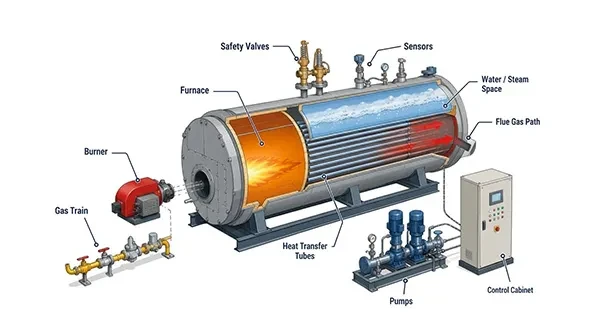
Boiler Shell: The outer pressure vessel that contains water and the generated steam.
Firebox: A large cylindrical chamber located at the center of the boiler shell, serving as the main combustion chamber for natural gas and also acting as the primary radiant heat transfer surface.
Return Chamber (Front/Rear Smoke Box): Located at the rear of the firebox, it causes the high-temperature flue gases produced by combustion to flow back. It is classified into dry-back (lined with refractory material) and wet-back (completely submerged in boiler water, offering higher thermal efficiency and longer service life) types.
Fire tubes (flue tubes): A dense bundle of small-diameter tubes surrounding the furnace. High-temperature flue gases from combustion pass through the interior of the fire tubes, transferring heat to the large volume of boiler water outside the tubes (typically a three-pass configuration).
Steam and water spaces: The upper part of the boiler shell is the steam space (equipped with a steam-water separator), while the lower part is the water space.
Economizer: Installed in the tail flue, it utilizes the residual heat of the exhaust flue gases to preheat boiler feedwater, thereby lowering the flue gas discharge temperature and improving thermal efficiency.
Condenser/Economizer (Standard on Modern Eco-Friendly Boilers): Taking advantage of the high water vapor content in gas boiler flue gases, this component further recovers the sensible heat and latent heat of water vapor from the flue gases, enabling thermal efficiency to exceed 98%.
Control Cabinet (PLC/Touchscreen): The intelligent control core that enables automatic ignition, load regulation, interlock protection, and fault alarms.
Safety Valve: Automatically relieves pressure in the event of overpressure to ensure boiler safety.
Pressure Gauge and Water Level Gauge: Safety devices that provide a visual display of the boiler’s operating pressure and water level.
Tel/Fax: 0086 371 63311291
WhatsApp/WeChat: 0086 13598899826
Email:info@taiguoboilers.com
Add: No.6 Zone, North Side of Konggang No.6 Road, Airport Economy Zone, Zhengzhou City, Henan Province, China




 0086 13598899826
 0086 13598899826
 info@taiguoboilers.com
