
Time: 2026-03-19 Click: 301 seen
When installing and designing industrial boiler systems, the feed water tank is often viewed merely as a simple water storage vessel. However, in a mature thermal system, the configuration of the feed water tank ensures
not only the continuity of the water supply, but also directly impacts the boiler’s service life, thermal efficiency and operational safety. Therefore, selecting an appropriately sized feed water tank for industrial boilers is critical.
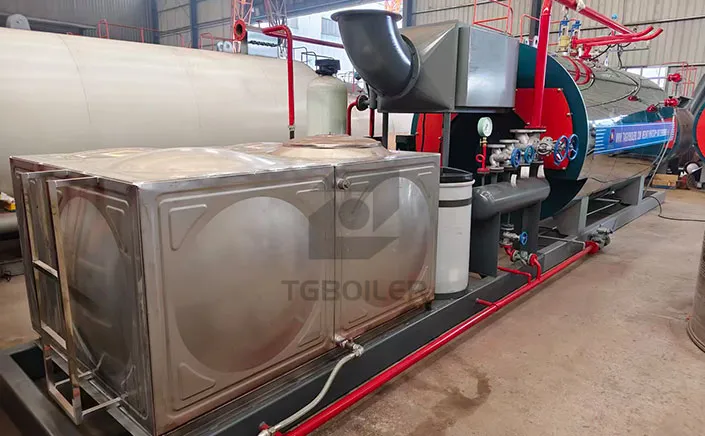
Buffering and continuous water supply
During boiler operation, the load fluctuates dynamically. As a reserve buffer tank, it ensures there is sufficient water in the boiler to maintain normal operation during brief periods of external water shortage or maintenance
of water treatment equipment, thereby preventing dry firing.
Preheating and thermal deaeration
By recycling condensate or introducing secondary steam, the feed water tank can preheat the cold water. This reduces thermal shock to the boiler body and removes dissolved oxygen from the water by raising its temperature.
This reduces oxygen corrosion and extends the service life of boiler piping.
Sedimentation and purification
Water entering the boiler requires softening treatment, and the tank serves as a secondary sedimentation basin, allowing minute impurities to settle at the bottom. Regular blowdown maintains the cleanliness of the feedwater.
Balancing system pressure
When the feed water pump draws water from the tank, the tank maintains a certain static head. This prevents cavitation in the feed water pump and ensures stable pump operation.
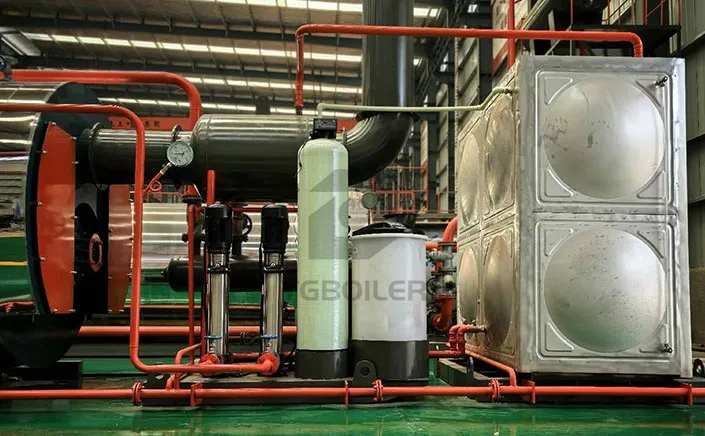
The capacity of a gas boiler tank should be determined based on the boiler’s makeup water volume. Typically, the system makeup water volume is calculated to be 3–5% of the boiler’s circulating water volume when
designing a boiler.
Water tank leaks are a common boiler malfunction. If the make-up water tank overflows, this may be due to a malfunction in the check valve on the make-up pump’s outlet, which can cause backflow into the tank after
the pump stops running. Additionally, if the float valve inside the tank fails to close automatically, this can also lead to overflow.
Selecting a water tank with a scientifically optimised configuration and high-quality materials is essential for the stable operation of gas-fired industrial boilers. For specific operating conditions (such as the makeup water
and condensate recovery rates), we need to conduct customised design work for each project.
For more information about industrial boilers water tank, please contact:
Email: info@taiguoboilers.com
WhatsApp: +86 13598899826
Tel/Fax: 0086 371 63311291
WhatsApp/WeChat: 0086 13598899826
Email:info@taiguoboilers.com
Add: No.6 Zone, North Side of Konggang No.6 Road, Airport Economy Zone, Zhengzhou City, Henan Province, China




 0086 13598899826
 0086 13598899826
 info@taiguoboilers.com
