
Time: 2026-08-13 Click: 86 seen
Steam is an indispensable energy source in animal feed production. It is widely used in processes such as feed pretreatment, pelleting, sterilization, drying, and maintaining product quality. Selecting the right steam boiler not only improves the quality of feed pellets but also effectively reduces fuel consumption and production costs.
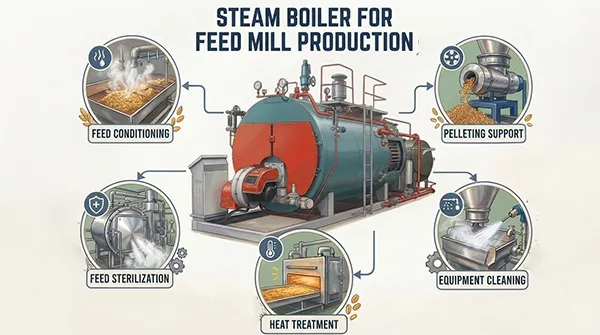
In animal feed production, steam is primarily used for conditioning, pelleting assistance, sterilization, heat treatment, and equipment cleaning. The main point of steam consumption is typically the conditioner located before the pellet mill, where saturated steam heats and moistens the feed powder before it is compressed.
Calculate the boiler capacity based on the feed mill’s hourly output, the proportion of pelletized feed, and the total steam consumption of the workshop’s equipment.
The boiler capacity must not only meet current production demands but also include an appropriate margin to accommodate future capacity expansion.
Fuel availability and local fuel prices are key factors in boiler selection.
Common fuels include: natural gas, diesel, biomass, and coal.
If local resources such as wood chips, rice husks, or other agricultural waste are abundant, a biomass steam boiler can be selected to reduce operating costs.
If the local natural gas supply is ample and there are high requirements for clean combustion and automated operation, a natural gas boiler is a good choice.
Stable steam pressure ensures consistent conditioning temperatures, thereby improving pelletizing efficiency and pellet hardness. Professional boiler manufacturers can recommend suitable operating pressures for a project based on the customer’s production line parameters.
Modern feed mill boilers should typically feature: high thermal efficiency, automatic combustion control, automatic water level control, comprehensive safety protections, and ease of operation and maintenance. These features can help feed mills reduce fuel consumption and labor costs.
Strict compliance with local environmental regulations requires prioritizing low-nitrogen gas boilers or standard-compliant biomass boilers.
Auxiliary Equipment: Consider whether environmental treatment equipment such as desulfurization, denitrification, or dust removal systems is required.
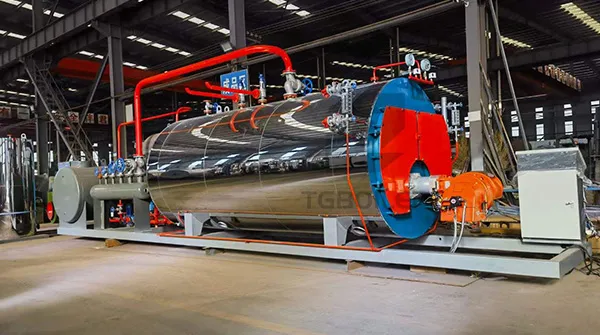
For feed mills with varying production capacities, operating hours, and boiler room conditions, TGBOILER offers three commonly used steam boiler configuration solutions. For most feed production projects, selections can be made based on steam capacity, pressure, fuel type, and daily load variations.
| Boiler Type | Suitable Feed Mill | Recommended Steam Capacity | Key Advantages |
| DZH Biomass Steam Boiler | Small feed plants | 1–6 t/h | Cost-effective, reliable performance |
| WNS Gas/Oil-Fired Steam Boiler | Small and medium-sized feed mills | 1–20 t/h | Stable operation, easy maintenance |
| Biomass Steam Boiler (SZL/DZL) | Feed mills with abundant biomass fuel | 2–20 t/h | Low fuel cost, renewable energy, environmentally friendly |
Tel/Fax: + 86-371-6331 1291
WhatsApp/WeChat: 8613598899826
Email:info@taiguoboilers.com
Add: 13th Floor, Building B, Zhengshang Xuefu Square, No. 277 Boxue Road, Zhengdong New District, Zhengzhou, Henan, China




 8613598899826
 8613598899826
 info@taiguoboilers.com
