
Time: 2026-03-05 Click: 288 seen
In the industrial thermal energy sector, when faced with aging equipment, declining efficiency, or non-compliant emissions, business owners encounter a dilemma: should they upgrade existing boilers or purchase a new,
high-efficiency unit outright?
As a professional boiler manufacturer, Henan Taiguo Boiler Manufacturing Co., Ltd. recommends evaluating multiple factors comprehensively before making a decision to select the most suitable solution.
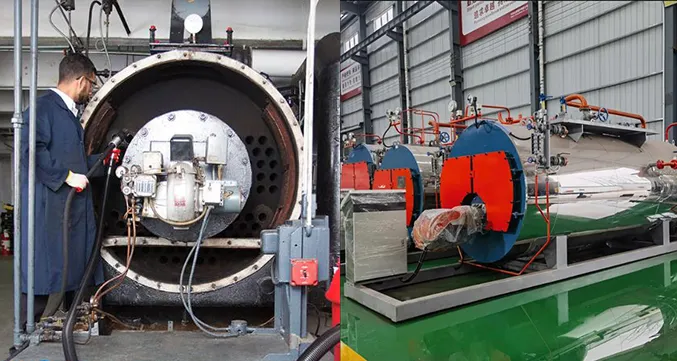
Suitable Scenarios: The boiler body is structurally sound, requiring only burner replacement, control system upgrades, or emission standard enhancements.
Low Initial Cost: Renovation expenses are significantly cheaper than replacing the entire boiler.
Minimal Downtime: Short production stoppages minimize operational disruption.
Emission Upgrades: Installing low-NOx burners enables compliance with increasingly stringent environmental regulations.
Long-Term Risks: Fails to address core component aging, leading to escalating maintenance costs over time.
Applicable Scenarios: Frequent failures in aging boilers, thermal efficiency below 80%, or thermal energy shortages due to production scale expansion.
High Thermal Efficiency: Modern boilers (WNS Series or DZL Series) equipped with condensers and intelligent control systems achieve thermal efficiency exceeding 95%.
Reduced fuel costs: Enhanced thermal efficiency saves fuel expenses. Typically recoups equipment costs within 2-3 years.
Fully automated control system: PLC touchscreen operation enables unattended operation, lowering labor costs.
Warranty assurance: New warranty coverage and extended lifespan (over 20 years) eliminate unplanned downtime risks.
| Consideration | Option A: Retrofitting Old Boiler | Option B: Purchasing New Boiler |
| Initial Investment | Low (Replace burner/control system) | Higher (Full unit purchase + installation) |
| Thermal Efficiency | Slight improvement (Approx. 82%–85%) | Extremely High (Up to 96% or more) |
| Fuel Costs | Increasing year by year | Significant decrease |
| Maintenance Frequency | High (Old parts are prone to wear) | Extremely Low (All brand-new components) |
| Environmental Compliance | Meets only basic emission standards | Exceeds future emission standards |
Therefore, if your budget is extremely tight and the boiler structure is relatively sound, retrofitting the boiler is the most suitable option.
However, if you are pursuing lower unit production costs and sustained stability, purchasing a modern energy-efficient boiler better aligns with your company's long-term development needs.
TGBOILER is a professional supplier of industrial boilers. Whether you want to upgrade your existing boiler system or purchase a new boiler,
📩 [contact the TGBOILER engineering team for a free customized solution and quote]
Email: info@taiguoboilers.com WhatsApp: +86 13598899826
Tel/Fax: 0086 371 63311291
WhatsApp/WeChat: 0086 13598899826
Email:info@taiguoboilers.com
Add: No.6 Zone, North Side of Konggang No.6 Road, Airport Economy Zone, Zhengzhou City, Henan Province, China




 0086 13598899826
 0086 13598899826
 info@taiguoboilers.com
