
Time: 2026-05-28 Click: 293 seen
When purchasing industrial boilers, companies tend to focus primarily on capacity and fuel type. As a result, they often face a dilemma during the selection process: should they choose an atmospheric (non-pressurized) boiler or a pressure boiler? This decision not only affects the company’s budget but also impacts the safety standards of the boiler room and the complexity of the boiler approval process.
This article will introduce atmospheric boilers and pressurized boilers
Atmospheric Boilers: These boilers feature a vent at the top, allowing the boiler body to be directly connected to the atmosphere. The internal water pressure is always equal to atmospheric pressure (0 MPa), eliminating the risk of explosion.
Pressurized Boilers: These are fully enclosed pressure vessels in which steam or hot water operates under high pressure (greater than 0.1 MPa). While they pose safety risks, they offer higher heating efficiency and the ability to deliver heat to greater heights.
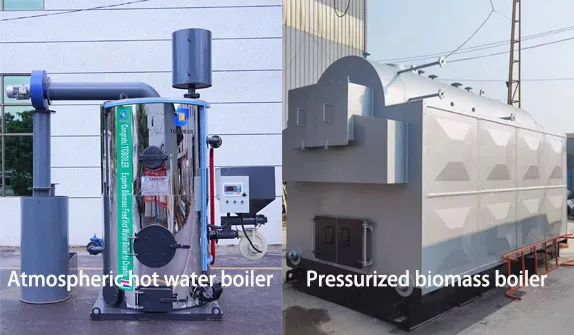
| Feature / Metric | Atmospheric Boiler | Pressurized Boiler |
| Operating Pressure | Always 0 MPa (Vent to air/atmosphere). | Greater than 0.1 MPa (Up to 1.25/1.6 MPa and above). |
| Max Medium Temperature | Water temperature < 95°C. | Steam / Water temperature > 100°C. |
| Safety Certification & Approval | Extremely low risk; requires very few local government approval procedures. | Strict pressure vessel regulations and codes (ASME / ISO / CE). |
| On-site Operator | Typically does not require a licensed or certified boiler operator. | Usually requires a full-time, certified boiler operator on-site. |
| Best Applications | Hotels, HVAC heating, small laundries, swimming pools, schools, hospitals, commercial buildings, etc. | Industrial manufacturing and production lines such as food, textile, chemical, and paper mills. |
| Environmental & Regulatory Approvals | Easy installation; typically no need for complex special equipment registration and annual inspection procedures. Inspection-free. | Classified as special equipment; must undergo strict government safety approvals and regular annual inspections. |
| Safety | Zero risk of explosion. Even if the vent pipe is clogged, the open-to-atmosphere boiler body design prevents overpressure explosions. | Potential risk of explosion. If overpressure or overtemperature occurs and safety valves fail, severe explosion accidents can happen. |
Choosing an Atmospheric Boiler: Ideal for heating and domestic hot water needs in schools, hotels, bathhouses, hospitals, or small-to-medium-sized residential communities, atmospheric boilers are the most economical and hassle-free choice.
Choosing a Pressure Boiler: Suitable for centralized heating in high-rise buildings, process steam requirements in large industrial parks, or projects requiring the transmission of thermal energy over long distances and across large areas.
As a professional boiler supplier, Henan Taiguo Boiler Manufacturing Co., Ltd. understands that local regulatory environments vary across different countries and regions.
For commercial heating projects seeking to simplify the installation process, our Vertical Atmospheric Boilers offer an extremely safe and efficient solution.
For industrial production requiring continuous high-temperature steam, our WNS gas-fired boilers and SZL biomass boilers are designed and manufactured in strict compliance with international pressure vessel standards. In fact, every pressure boiler we ship undergoes rigorous hydrostatic testing at 1.25 to 1.5 times the design pressure before leaving the factory to ensure absolute safety.
📩 “Still unsure which boiler meets local regulations in Mexico, Chile, or Southeast Asia? Contact our senior engineers today for a free boiler selection and compliance consultation!”
📩 [Contact TGBOILER Engineering Team for a Free Custom Solution & Quote]
Email: info@taiguoboilers.com WhatsApp: +86 13598899826
Tel/Fax: 0086 371 63311291
WhatsApp/WeChat: 0086 13598899826
Email:info@taiguoboilers.com
Add: No.6 Zone, North Side of Konggang No.6 Road, Airport Economy Zone, Zhengzhou City, Henan Province, China




 0086 13598899826
 0086 13598899826
 info@taiguoboilers.com
