
Time: 2025-11-13 Click: 430 seen
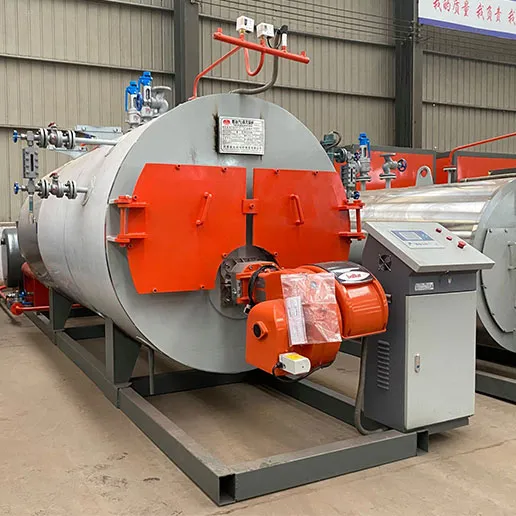
New environmentally friendly natural gas boilers are gradually replacing traditional coal-fired boilers as the mainstream product in industrial production. Based on the type of medium, fire-tube natural gas boilers can
be categorized into three main types: natural gas steam boilers, natural gas hot water boilers, and natural gas thermal oil boilers. Compared to traditional boilers, natural gas boilers offer distinct advantages.
1. Space Savings
Natural gas boilers eliminate the need for coal ash storage, saving floor space.
2. Reduced Auxiliary Water Consumption
While coal and gas boilers require equal amounts of water for normal operation, gas boilers save on auxiliary water used for dust removal, slag disposal, and other pollution control measures.
3. Cost Efficiency
Natural gas boilers feature simplified equipment and require fewer operators, significantly reducing labor and welfare costs.
4. Electricity Savings
Gas boilers require fewer fuel delivery systems, operate at lower power levels, and run continuously for shorter durations, resulting in reduced electricity consumption and savings.
5. Reduced Labor Intensity
Gas boilers feature high automation levels, making them less labor-intensive than traditional boilers.
6. Flexible Boiler Room Layout
Gas boiler rooms offer flexible configurations, require minimal floor space, and operate with low noise levels.
7. Minimal Environmental Impact
Natural gas is a clean energy source, resulting in low environmental pollution during gas boiler operation.
Compared to traditional boilers, natural gas boilers offer significant advantages. Additionally, they feature factory-assembled units, simple installation, user-friendly operation, intelligent control systems, fully automatic
operation, and safe, stable performance.
Tel/Fax: 0086 371 63311291
WhatsApp/WeChat: 0086 13598899826
Email:info@taiguoboilers.com
Add: No.6 Zone, North Side of Konggang No.6 Road, Airport Economy Zone, Zhengzhou City, Henan Province, China




 0086 13598899826
 0086 13598899826
 info@taiguoboilers.com
